
A potential customer opens ChatGPT and types “best [what you do] for [their problem].” A few names come back. If yours isn’t one of them, you didn’t lose on price or pitch you were never in the room. In 2026, that room is crowded: OpenAI reported ChatGPT reached about 900 million weekly active users by February (TechCrunch, February 2026).
I’m testing this on seofreelancerguru.com and I’ll show you what actually moves the needle. Here’s the promise: a concrete, evidence-backed playbook for getting recommended by ChatGPT, not a list of hopeful guesses.




Key Takeaways
- Getting recommended means being named in ChatGPT’s answer, not just ranking on Google and the two barely overlap.
- In 2025, only about 8% of ChatGPT’s in-text citations ranked in Google’s top 10 (Ahrefs, 2025). Your #1 ranking won’t save you.
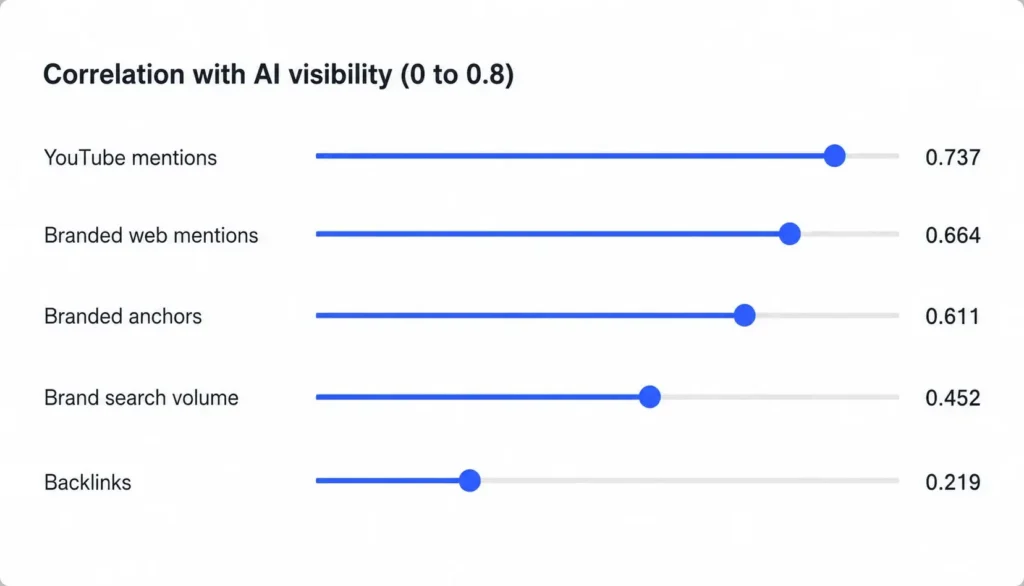
- YouTube mentions are the single strongest signal (0.737 correlation), far ahead of backlinks (0.218) (Ahrefs, 2025).
- Off-site presence decides recommendations — Reddit, review sites (G2, Trustpilot), and third-party “best of” lists do the persuading.
- It’s not one-and-done: only 25.6% of cited domains overlap even between ChatGPT’s own reasoning modes (Semrush, 2026).
Getting recommended means ChatGPT names your business in its answer when someone asks for a solution, either as a linked citation or a plain brand mention. It’s the conversational cousin of ranking, but it runs on different rules. With ChatGPT holding roughly 79% of global AI-chatbot traffic in 2026 (StatCounter, 2026), being named there is its own distribution channel.
There’s a distinction worth holding onto. A citation is ChatGPT pointing to your page as a source. A recommendation is ChatGPT vouching for your brand as an answer. You want both, and the same signals tend to earn them.
Because ChatGPT mostly pulls from a different pool than Google’s top results. In 2025, Ahrefs analyzed 15,000 queries and found only about 8% of ChatGPT’s in-text citations ranked in Google’s top 10, and just 6.1% of its references did (Ahrefs, 2025). Your hard-won ranking is almost irrelevant to whether ChatGPT names you.
This surprises people who’ve spent years on classic SEO. The skills transfer, but the scoreboard doesn’t. ChatGPT weighs brand mentions, third-party validation, and freshness over raw Google position. So the question shifts from “how do I rank?” to “how do I get talked about where ChatGPT is reading?”
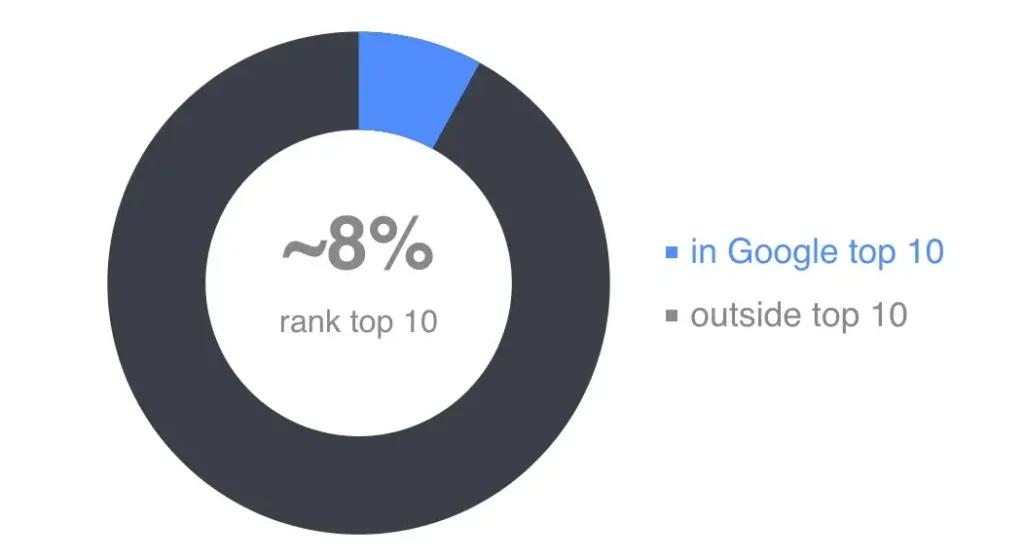
Source: Ahrefs, AI search overlap study, 2025.
A 2026 EMGI analysis of 150 SaaS brands put it starkly: it reported that 81% of ChatGPT-recommended brands didn’t appear in Google’s top 10, and 44% of Google’s top-10 brands earned zero ChatGPT citations (EMGI Group, 2026). Treat the exact figures as vendor-reported, but the direction matches the Ahrefs data: two separate scoreboards.
Off-site brand signals, above all. In 2025, Ahrefs studied 75,000 brands and found YouTube mentions showed the strongest correlation with AI visibility at about 0.737, with branded web mentions at 0.664 while traditional backlinks trailed at roughly 0.218 (Ahrefs, 2025). What people say about you off your site matters more than what you publish on it.
Read that ladder carefully, because it rewrites your priorities. Backlinks, the currency of classic SEO, correlate about three times weaker than plain brand mentions. Getting your name said on YouTube, in roundups, across the web beats another link-building sprint.
Earn off-site mentions where ChatGPT reads, make your own pages easy to quote, and keep both fresh. Those three moves, worked in order, are what shift recommendations. In 2025, Ahrefs found near-zero correlation between raw content volume and AI visibility so this is about clarity and presence, not publishing more. Here’s the sequence I run.
State plainly what you are, who you help, and how you’re different, in extractable language on your homepage, about, and product pages. ChatGPT recommends brands it can confidently describe. Use question-style headings, short paragraphs, and a one-sentence answer at the top of each section so a model can lift it cleanly.
Mark up your Organization, Product, and Review data with schema. It won’t win recommendations alone, but it reinforces which entity you are and makes your claims machine-readable. Keep your positioning and stats consistent across every page contradictions quietly erode the trust that earns a mention.
Since YouTube is the strongest single signal, get your brand said on video your own channel, guest appearances, reviews, or recorded podcasts. A demo, a walkthrough, an interview: each one plants a branded mention in the source ChatGPT correlates with most. It’s the single biggest lever on this list.
Reddit and review platforms punch far above their weight. In 2026, a 5W Public Relations study reported that Wikipedia and Reddit together drive over 25% of U.S. ChatGPT citations (PRNewswire, 2026). Contribute genuinely in relevant subreddits and build real reviews on G2, Trustpilot, or Capterra. Don’t astroturf fake activity gets removed and backfires.
For “best X” queries, ChatGPT leans hard on aggregators and listicles. One 2026 analysis of product answers found ChatGPT drew heavily on YouTube (19%), Reddit (19%), and RTINGS (~16%), then outlets like Forbes and PCMag, while brand-owned domains barely registered (cloro.dev, 2026). Getting listed on the roundups your buyers trust is disproportionately effective.
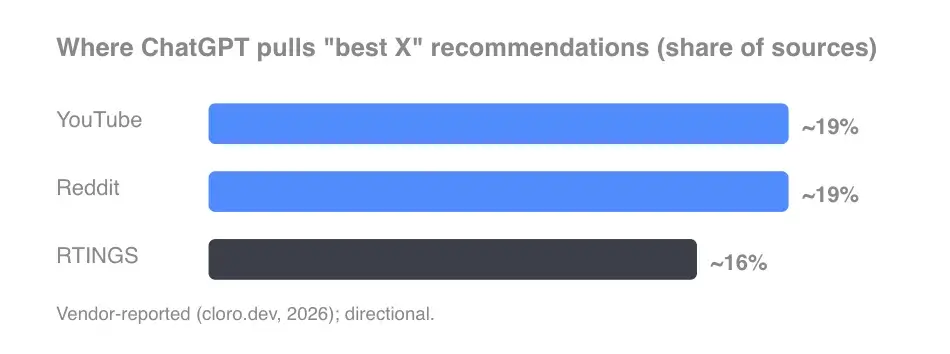
Source: cloro.dev product-answer analysis, 2026 (Tier-4, attributed).
Wikipedia is one of ChatGPT’s most-cited sources. A well-sourced entity strengthens how confidently ChatGPT understands and describes you. Only pursue it if you genuinely meet notability guidelines a rejected or deleted page is wasted effort, and self-promotional edits get reverted fast.
ChatGPT favors recent sources. Multiple 2026 studies link content recency to citation rates, and Seer Interactive’s analysis found fresher content earns markedly more AI visibility (Seer Interactive, 2026). Update your cornerstone pages, keep earning new mentions, and treat visibility as a habit, not a one-time project.
Want a shortcut? I’ll run a free ChatGPT visibility check on your business book a 20-minute call → and I’ll show you which questions ChatGPT answers with a competitor’s name instead of yours.
Run a fixed set of buyer questions through ChatGPT on a weekly cadence and log whether you’re named. There’s no rank tracker for this, so you build a simple panel: pick 15 questions your customers actually ask, run each weekly, and record whether ChatGPT cites you, the position, and which competitors appear. Your trend over weeks is the signal, not any single reply.
I log mine in a plain spreadsheet, one tab per platform, one row per query per week. Nothing fancy beats consistency here.
Instability is the reason you track over time. In 2026, Semrush found only 25.6% of cited domains overlapped even between ChatGPT’s own low- and high-reasoning modes (Semrush, 2026).
The biggest one is treating ChatGPT like Google. Chasing rankings, hoarding backlinks, and publishing high volumes of thin content all underperform, because ChatGPT weights brand mentions and freshness instead. In 2025, Ahrefs found essentially no correlation between content volume and AI visibility (Ahrefs, 2025). More posts is not the answer.
A few specific traps to skip. Don’t stuff pages with keywords or hidden “instructions to the AI” there’s no evidence it works and it risks penalties. Don’t astroturf Reddit or fake reviews; platforms remove it and ChatGPT’s trust signals suffer. And don’t optimize once and walk away with citation sets this unstable, visibility needs maintenance.
Earn off-site brand mentions where ChatGPT reads YouTube, Reddit, review sites, and “best of” listicles while making your own pages easy to quote. In 2025, Ahrefs found YouTube mentions were the strongest AI-visibility signal at 0.737, far above backlinks at 0.218 (Ahrefs, 2025).
Barely. In 2025, Ahrefs found only about 8% of ChatGPT’s in-text citations ranked in Google’s top 10 (Ahrefs, 2025). Google SEO builds useful foundations, but ChatGPT recommendations are earned mainly through off-site brand signals and freshness, not search position.
Expect 60 to 90 days of consistent off-site work before reliable movement, since ChatGPT re-crawls and re-weights sources slowly. Because only 25.6% of cited domains overlap between its own reasoning modes (Semrush, 2026), track a trend across weeks rather than judging any single answer.
Less than you’d think. In 2025, Ahrefs measured backlinks at about 0.218 correlation with AI visibility roughly three times weaker than plain branded web mentions at 0.664 (Ahrefs, 2025). Earning mentions of your brand name outperforms traditional link building for getting recommended.
YouTube leads, followed by Reddit, review sites (G2, Trustpilot, Capterra), and third-party “best of” lists. A 2026 5W study reported Wikipedia and Reddit alone drive over 25% of U.S. ChatGPT citations (PRNewswire, 2026). Prioritize where your buyers already gather.
Getting recommended by ChatGPT isn’t a harder version of SEO it’s a different game with its own board. The winners aren’t the sites with the most pages or the best Google rankings. They’re the brands that get named, again and again, in the places ChatGPT trusts.
Here’s the short version:
I’m testing all of this live on my own site, including what doesn’t work. If you’d rather have a specialist run it for you, let’s talk →.
Sources retrieved 2026-07-18: