

Someone asks ChatGPT which SEO freelancer to hire, or asks Perplexity how to fix their rankings, and an answer comes back with three sources cited. Are you one of them? In 2026, that question matters as much as your Google position, and often more. Ranking first no longer guarantees you’re in the answer at all: about 88% of citations in Google’s AI Mode come from pages that don’t even appear in the organic results (Moz, via Ahrefs, 2026).
I’m running this playbook live on seofreelancerguru.com, and I’ll show you what’s working, what isn’t, and how I measure it. Here’s the promise: by the end, you’ll have a reproducible GEO system, not another list of vague tips.


Key Takeaways
- GEO means getting cited in AI answers (ChatGPT, Perplexity, Google AI Overviews), not just ranking blue links.
- AI Overviews cut organic click-through by about 61% on the queries they appear on (Seer Interactive, 2026) yet cited brands earn ~35% more organic clicks.
- Most AI citations come from off-site signals YouTube, Reddit, and mentions matter more than one more blog post.
- AI engines barely overlap: only about 11–12% of cited sources are shared across platforms, so you optimize each one separately.
- Measure with citation share of voice across 15 tracked queries. The full method is in this guide.
Generative engine optimization is the practice of getting your content cited, quoted, and recommended inside AI-generated answers, rather than ranked as a link. As of February 2026, OpenAI reported that ChatGPT reaches about 900 million weekly active users (OpenAI, reported February 2026). When those users ask a question, GEO decides whether your brand is in the answer.
Traditional SEO earns a position. GEO earns a mention. The difference is subtle until you notice that a user can get their whole answer without a single click reaching your site. That’s the shift GEO responds to.
SEO optimizes for ranked links. GEO optimizes for being cited inside a generated answer. Answer engine optimization (AEO) is the narrower, older sibling focused on featured snippets and voice answers. I use GEO as the umbrella term throughout this guide and mention AEO only here, because AI systems reward consistent entity terminology and I don’t want to confuse them by swapping labels.
| SEO | AEO | GEO | |
|---|---|---|---|
| Goal | Rank a link | Win the snippet/voice answer | Get cited in the AI answer |
| Surface | Google results page | Featured snippets, voice | ChatGPT, Perplexity, AI Overviews |
| Success metric | Position + clicks | Snippet ownership | Citation share of voice |
| Main lever | On-page + backlinks | Structured answers | Off-site signals + extractability |
Being cited isn’t one thing. On Perplexity it’s a numbered footnote. In Google AI Overviews it’s a linked card. In ChatGPT it might be an inline link or a plain brand mention with no link at all. Each surface counts a citation differently, which is exactly why a single “am I visible?” checkbox doesn’t work.
Because the click you used to win is disappearing, and the citation that replaced it goes to a different set of pages. In 2026, Seer Interactive found that organic click-through on AI Overview queries fell about 61% (from 1.76% to 0.61%), with paid CTR down roughly 68% (Seer Interactive, 2026). That’s the cost of doing nothing.
But the story isn’t only loss. Brands that get cited inside an AI Overview earn about 35% more organic clicks, and 91% more paid clicks, than uncited brands on the same result (Seer Interactive, via QuickSEO, 2026). The click didn’t vanish. It concentrated. GEO is how you end up on the winning side of that split.
One honest caveat: that 61% drop isn’t frozen. Seer’s data shows CTR partially rebounding in early 2026 as users adjust to AI Overviews. Treat the number as a live signal, not a permanent verdict.
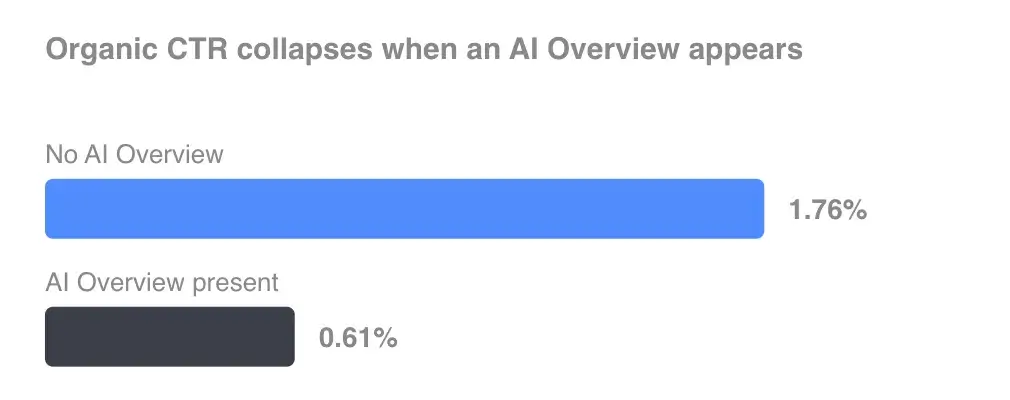
Source: Seer Interactive, AIO Impact on Google CTR: 2026 Update.
The drop is concentrated on informational queries, the “how to” and “what is” searches that most blog content targets. If your traffic model assumes a top-three ranking equals clicks, AI Overviews quietly break that assumption. The ranking can stay; the visit doesn’t come.
Here’s the part that surprises people: ranking #1 does not guarantee an AI citation. In 2026, Moz found that about 88% of citations in Google’s AI Mode come from pages that don’t appear in the organic SERP for that query (Moz, via Ahrefs, 2026). AI systems draw on a wider, different pool than the ten blue links. Your rankings and your citations are two separate scoreboards now.
The five surfaces that matter in 2026 are ChatGPT, Perplexity, Google AI Overviews, Gemini, and Microsoft Copilot. Each pulls sources differently, and they barely agree with each other: across several independent 2026 studies — Averi’s analysis of 680 million citations and Whitehat SEO’s of 118,000 responses among them — only about 11–12% of cited domains overlap between engines, and roughly 71% of sources appear on just one platform (Whitehat SEO, 2026). Treating them as one audience is the most common GEO mistake I see.
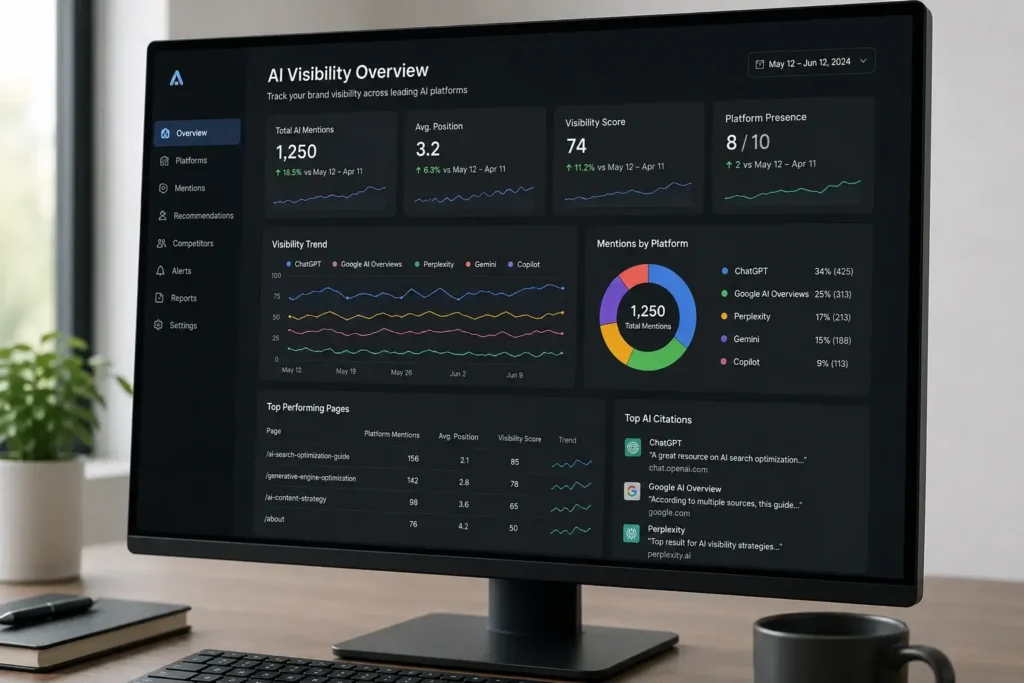
ChatGPT leans on freshness and brand mentions across the open web, and refreshes what it surfaces frequently. Perplexity behaves more like a live search engine, favoring recent, well-structured pages it can quote cleanly. Google AI Overviews pull more heavily from top-ranked pages than the chat engines do, so classic SEO still feeds them. Gemini and Copilot blend their parent ecosystems’ signals. Different rules, different winners.
Because a page that Perplexity loves may be invisible in ChatGPT. With only about 12% cross-platform overlap, a single generic effort spreads thin across five different selection systems. The practical move is to pick one or two surfaces where your audience actually asks questions, and go deep there first.
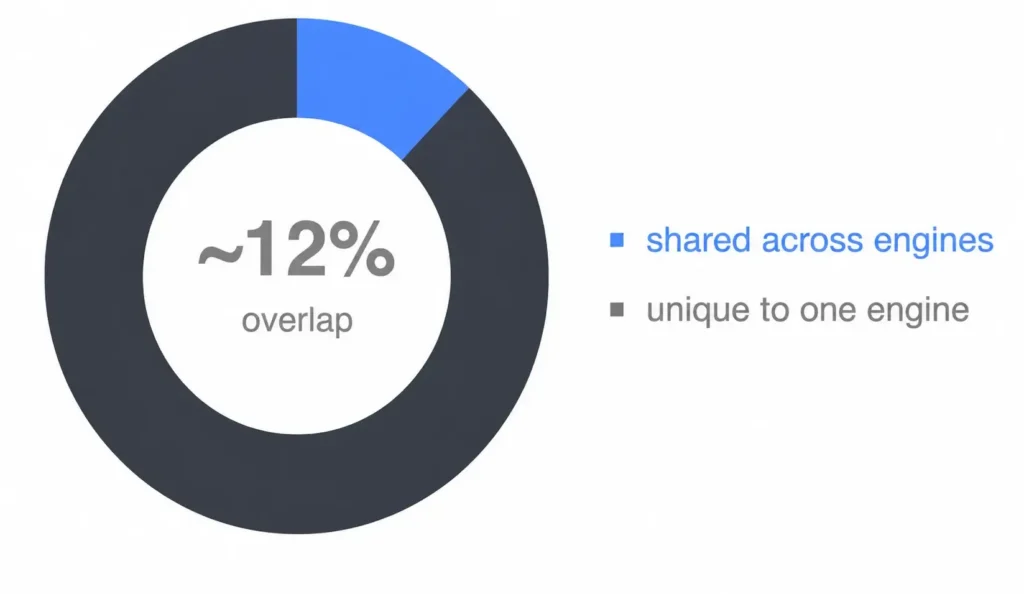
Source: Whitehat SEO citation study, 2026.
GEO runs on two engines: on-site work that makes each page extractable, and off-site work that makes AI systems trust you enough to cite. The uncomfortable truth is that the second engine does most of the driving. In 2026, Ahrefs’ study of 75,000 brands found off-site signals like YouTube mentions and branded web mentions correlate with AI visibility far more strongly than backlinks (Ahrefs, March 2026). You can’t write your way in alone.
On-site GEO is about giving AI a clean sentence to lift. Open each section with a direct, self-contained answer of 40 to 60 words that states a claim, a number, and a source. Add schema so machines can parse your entities. Keep terminology consistent so the system knows “GEO” on page one is the same “GEO” on page nine. This is table stakes, not the finish line.
This is where citations are won. YouTube shows the single strongest correlation with AI visibility in Ahrefs’ data, at roughly 0.737, well ahead of branded web mentions and dramatically ahead of backlinks at about 0.22 (Ahrefs, 2026). Reddit threads, review platforms, guest mentions, and video are doing the persuading. A blog post is the thing AI links to; off-site presence is what convinces it to.
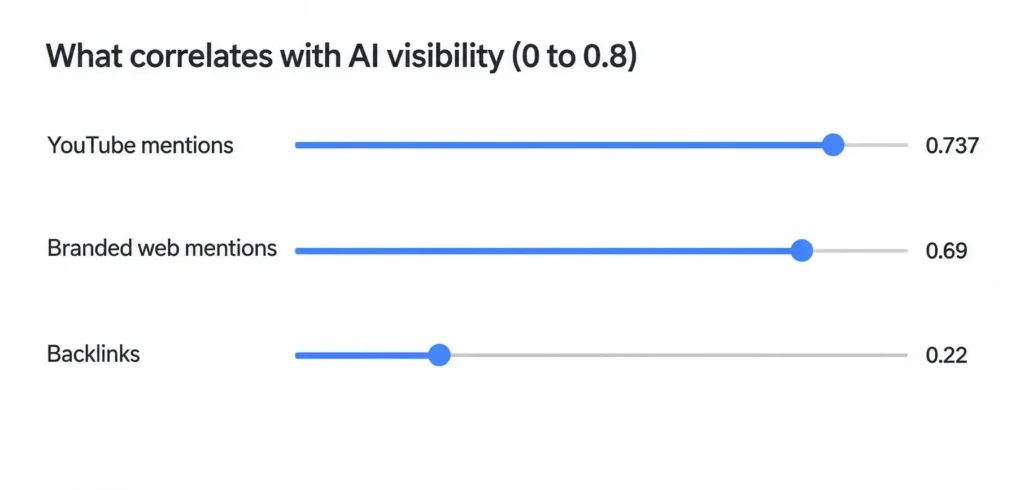
Source: Ahrefs, 75,000-brand AI visibility study, 2026.
AI systems, ChatGPT especially, favor recently updated sources. I re-touch cornerstone pages on roughly a 30-day cycle: refresh a stat, add a new example, update the “last modified” date honestly. It’s unglamorous, and it moves citations. how to get recommended by ChatGPT for the platform-specific version of this loop.
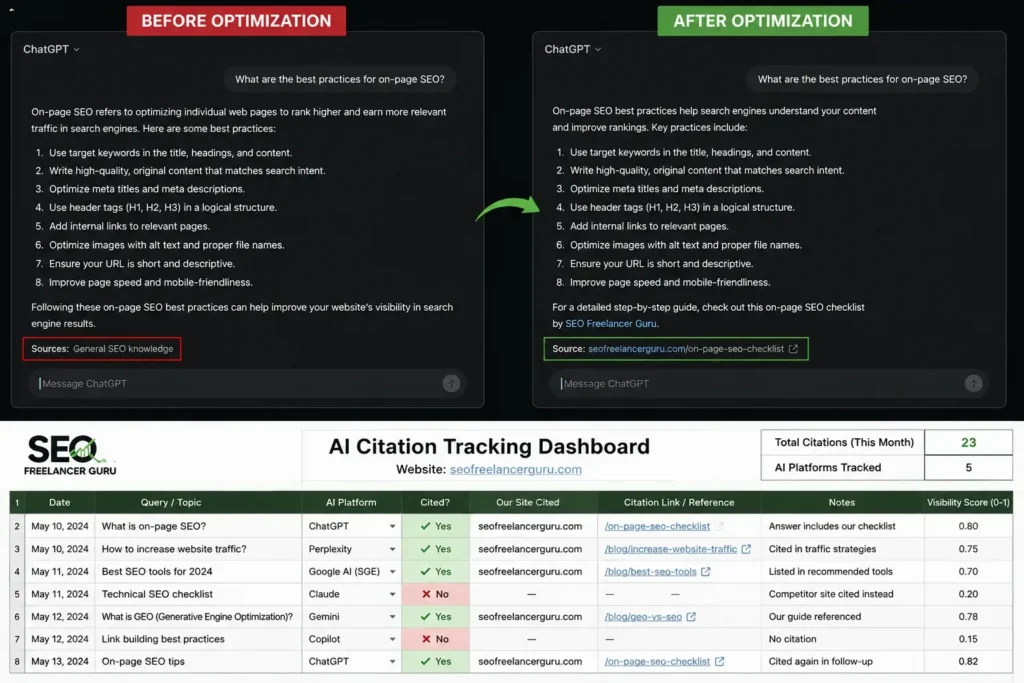
You measure GEO with citation share of voice: across a fixed set of questions your customers actually ask, how often does an AI answer name you versus a competitor? This is the metric most guides hand-wave. It’s also the one that survives the fact that AI answers change daily. Rankings have a rank tracker; citations need this.
Here’s the method I run, and you can copy it exactly.
Pick 15 questions your buyers ask, spanning the funnel definitional (“what is GEO”), comparative (“best SEO freelancer for SaaS”), and bottom-funnel (“how much does an SEO consultant cost”). Once a week, run each query through ChatGPT, Perplexity, and Google AI Overviews. Log three things per query: were you cited (yes/no), what position, and which competitors appeared. Your share of voice is your citations divided by total available citations. Track the trend, not any single day.
Complement the manual panel with platform data. In GA4, build a segment for referrals from AI hosts (chatgpt.com, perplexity.ai, gemini.google.com) to catch the clicks that do come through. In Search Console, watch for impression patterns on informational queries where AI Overviews appear. Neither is complete on its own; together with the 15-query panel, they triangulate.
Want to see where you stand? I’ll run a free GEO visibility check on your site book a 20-minute call →. You’ll get your current citation share of voice across the platforms your audience uses.
Right now, on seofreelancerguru.com, I’m running a controlled GEO test to see how fast off-site work moves the citation needle, and I’m publishing the results as they come in rather than after the fact. The point is to show the method honestly, including where it stalls.
The setup is simple: a baseline citation-share reading across my 15-query panel, then a focused off-site push (a YouTube walkthrough, genuine Reddit contributions, and a freshness pass on this pillar), holding on-site structure constant. I’m watching Perplexity first, because as a B2B-leaning audience it’s where my buyers actually search.
A realistic GEO plan runs in three 30-day phases: build the extractable foundation, push off-site signals, then measure and refresh. Don’t expect week-one citations. Most practitioners, myself included, see the first meaningful movement around the 60 to 90-day mark, which lines up with how slowly AI systems re-crawl and re-weight sources.
Audit your top ten pages for answer-first structure. Add or fix schema (Article, FAQPage, Organization). Lock your entity terminology. Set up the 15-query tracking panel and take a clean baseline reading. Nothing here is glamorous; all of it is prerequisite.
Publish one substantive YouTube video on your core topic, because it’s the strongest single signal. Contribute genuinely to two or three relevant Reddit or community threads, sharing method, not links. Earn a couple of real mentions through guest content or expert roundups. This is the phase that actually moves citations.
Re-run your 15-query panel and compare to baseline. Update your foundation pages with fresh stats and dates. Double down on whichever surface responded, and quietly drop whatever didn’t. Then start the loop again — GEO isn’t a project you finish, it’s a cadence you keep. Thinking about outside help?
GEO is the practice of getting your content cited and recommended inside AI-generated answers from tools like ChatGPT, Perplexity, and Google AI Overviews, rather than only ranking as a link. With ChatGPT alone reaching ~900 million weekly users in 2026 (OpenAI, 2026), being in the answer is the new visibility.
No. SEO earns a ranked position in a list of links; GEO earns a citation inside a generated answer. They share fundamentals like quality content and crawlability, but their success metrics differ rankings versus citation share of voice. In 2026, about 88% of AI Mode citations come from pages outside the organic SERP (Moz, 2026).
No, you need both. Google AI Overviews still pull heavily from top-ranked pages, so strong SEO feeds your GEO. And classic organic clicks haven’t disappeared; they’ve concentrated toward cited brands, who earn about 35% more clicks (Seer Interactive, 2026). GEO extends SEO; it doesn’t retire it.
Use citation share of voice: across 15 fixed customer questions, track how often AI answers cite you versus competitors, weekly, across ChatGPT, Perplexity, and AI Overviews. Add a GA4 AI-referral segment for clicks that come through. Since only ~12% of citations overlap across platforms (Whitehat SEO, 2026), measure each surface separately.
Realistically, 60 to 90 days before you see reliable movement. AI systems re-crawl and re-weight sources slowly, and off-site signals like YouTube and mentions take time to accumulate. Foundation work shows up first; citation gains follow. Anyone promising citations in week one is selling, not measuring.
Optimize for where your audience asks questions. For broad consumer reach, start with ChatGPT and its ~900 million weekly users. For B2B and research-heavy buyers, start with Perplexity, which behaves like a live search engine. With only ~11–12% cross-platform overlap (Whitehat SEO, 2026), pick one and go deep before expanding.
GEO isn’t a replacement for SEO — it’s the second scoreboard you now have to play on. The clicks didn’t vanish; they concentrated toward the brands AI systems choose to cite. Win that, and you’re visible in the answer itself.
The takeaways are simple, even if the work isn’t:
GEO is a moving target, and I’m testing it live on my own site — including the parts that don’t work. If you’d rather have a specialist run it for you, let’s talk →. And when you’re ready to go deeper, start with how to get recommended by ChatGPT
Sources retrieved 2026-07-18: