
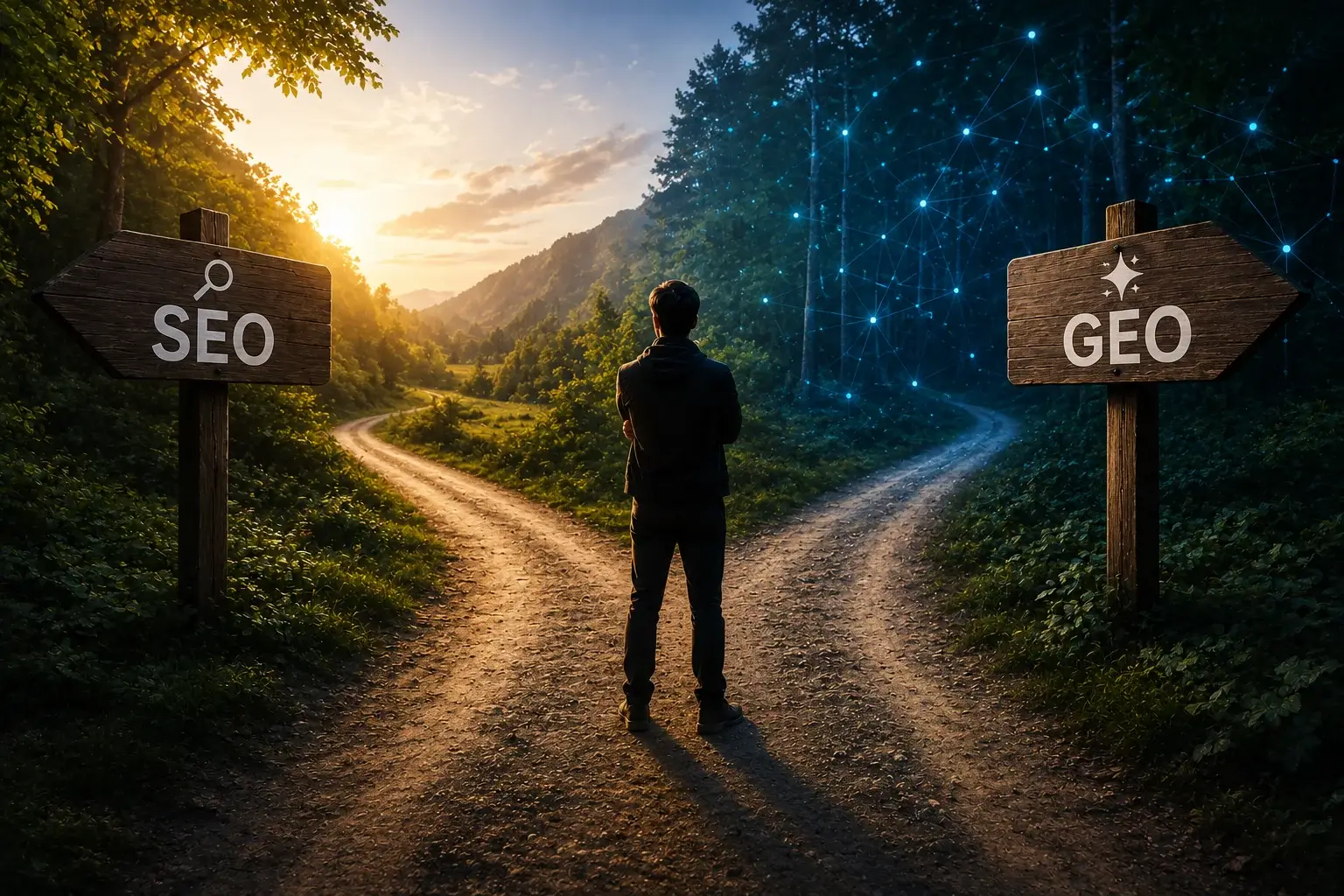
Every week someone asks me the same thing: “Is SEO dead, and should I be doing this GEO thing instead?” The honest answer annoys people because it’s not a clean either/or. GEO and SEO chase two different prizes a spot in the AI-generated answer versus a spot in the ranked list of links and in 2026 you increasingly need both, because the two are quietly merging.
I run both on seofreelancerguru.com, so this isn’t a theory piece. Below is the side-by-side that actually matters: where they overlap, where they genuinely diverge, and how to decide where your next dollar goes.




Key Takeaways
- The one-line difference: SEO earns you a ranking in a list of links; GEO earns you a citation inside an AI-generated answer. Different scoreboard, different rules.
- SEO is not dead. Google still runs ~5 trillion searches a year and holds ~90% search market share (Search Engine Land, 2025; StatCounter, 2026).
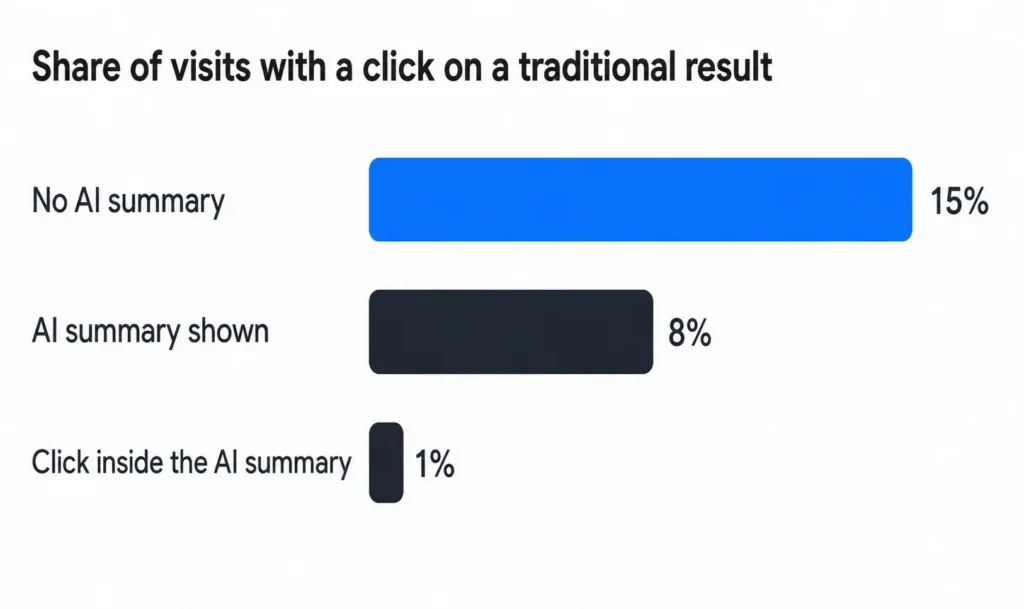
- But AI is eating the clicks. With an AI summary present, users clicked a traditional result in only 8% of visits vs 15% without one (Pew Research, 2025).
- They’re merging. The majority of AI Overview citations still come from pages that rank organically but the top-10 lock is loosening fast, from ~76% to ~38% in a year (Ahrefs, 2026).
- The answer is “both,” weighted by where your buyers already are and SEO foundations feed GEO, so it’s rarely a real either/or.
SEO optimizes to rank a page in a list of links; GEO optimizes to get your brand cited inside an AI-generated answer. Traditional SEO wins when your URL sits in Google’s top results and someone clicks it. Generative Engine Optimization (GEO) wins when ChatGPT, Perplexity, or a Google AI Overview names you in the answer itself often with no click at all.
That single shift from earning a click to earning a mention cascades into different signals, metrics, and timelines. For the full GEO framework, see my GEO playbook → this post is the honest comparison of the two disciplines side by side.
Here’s the comparison I keep coming back to. Read it as “same foundations, different emphasis,” not “two separate jobs.”
| Dimension | Traditional SEO | GEO |
|---|---|---|
| Goal | Rank a page, earn the click | Get cited/named in the AI answer |
| Primary surface | Google/Bing results pages | ChatGPT, Perplexity, AI Overviews, Gemini |
| Strongest signal | Backlinks + on-page relevance | Brand mentions + freshness + quotability |
| Key metric | Rankings, organic traffic, CTR | Citation share of voice, brand mentions |
| Timeline | 3–6+ months to rank | Faster to move, but unstable week to week |
| Content emphasis | Depth, keywords, link-worthiness | Answer-first, source-backed, off-site presence |
SEO is not dead; it’s still where nearly all the search volume lives. In 2025, Google disclosed it runs more than 5 trillion searches a year roughly 14 billion a day (Search Engine Land, 2025) and it still holds around 90% of the global search market (StatCounter, 2026). By comparison, one 2025 analysis estimated traditional organic search still drives on the order of 345 times more traffic than ChatGPT, Gemini, and Perplexity combined (Similarweb, 2025, vendor-reported).
So if a “SEO is over” thread ever tempts you to pull your budget, don’t. The volume is overwhelmingly still in classic search. What’s changing isn’t search’s size it’s what happens on the results page once someone gets there.
AI answers are quietly draining clicks from the links below them, which is exactly why GEO now matters. In a 2025 study, Pew Research tracked real browsing and found that when an AI summary appeared, users clicked a traditional search result in just 8% of visits, versus 15% when no summary was shown and only 1% clicked a link inside the AI summary itself (Pew Research, 2025).
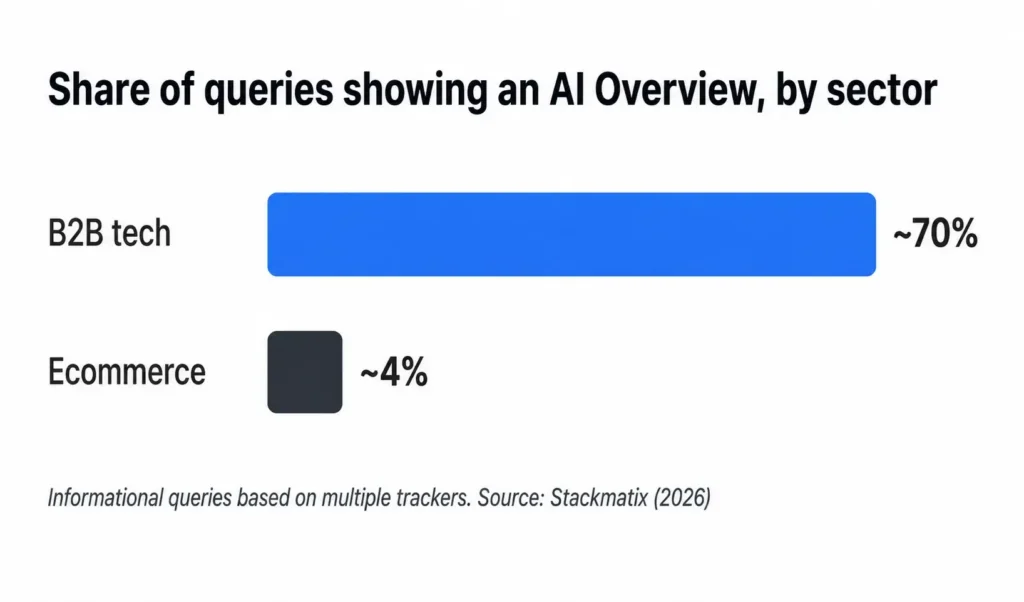
And those summaries are everywhere now. Depending on whose tracker you trust, AI Overviews appear on roughly 43% to 48% of Google searches in 2026, up from the low teens a year earlier (Similarweb, 2026; BrightEdge, 2026 both vendor-reported; treat the exact figure as a range). The click you used to win by ranking #1 is increasingly answered before anyone scrolls. That’s the gap GEO fills. For the Google-specific version, see my AI Overview optimization guide → .
A large share of AI citations still come from pages that rank organically, so your SEO foundations are also your GEO foundations. Two 2026 studies disagree on the exact number but agree on the direction: Ahrefs found about 38% of AI Overview citations come from pages in the organic top 10, with most of the rest ranking somewhere in the top 100 (Ahrefs, 2026), while BrightEdge put 54.5% of AIO citations on pages that rank organically at all (BrightEdge, 2025). Perplexity is even more SEO-friendly: about 28.6% of its citations rank in Google’s top 10 (Ahrefs, 2025).
So the shared foundation crawlable, indexable pages; clear topical relevance; genuinely useful content; a credible entity pays off on both boards. Do that work once and it serves rankings and citations together.
GEO leans on off-site brand signals and freshness far more than classic SEO does. This is the part people underestimate. In a 2025 study of 75,000 brands, Ahrefs found YouTube mentions correlated most strongly with AI visibility at 0.737 and branded web mentions at 0.664, while traditional backlinks trailed at about 0.218 (Ahrefs, 2025). The currency of SEO backlinks correlates roughly three times weaker than plain brand mentions for AI citations.
Freshness diverges too. AI engines heavily favor recently updated pages, and updating old content counts as “fresh” for Perplexity, 65% of cited pages had been updated within the past year (Seer Interactive, 2026). Classic SEO tolerates evergreen pages that haven’t been touched in years; GEO punishes them. And the top-10 lock that once tied AI citations to rankings is loosening Ahrefs measured it falling from about 76% to 38% in a single year (Ahrefs, 2026). A #1 ranking no longer guarantees the citation.
Weight toward SEO for the volume, but carve out a real slice for GEO because the foundations overlap and the AI curve is steep. Here’s the split I’d defend for most small and mid-sized businesses in 2026:
The exact ratio depends on your buyers. If your audience has clearly moved to ChatGPT and Perplexity for research, tilt harder toward GEO. If they still Google everything, keep the weight on SEO but don’t skip GEO, because AI Overviews are answering their questions before they scroll. Not sure where you land? That’s a 20-minute conversation. Unsure whether a consultant even has this straight? See my Questions to Ask before Hiring an SEO Consultant → .
Not sure where to invest GEO, SEO, or both? Book a free strategy call → and I’ll map your split based on where your customers actually search, not a generic ratio.
You don’t rebuild you extend. If you’re doing solid SEO today, the move to GEO+SEO is additive, in this order:
No. Google still runs roughly 5 trillion searches a year and holds about 90% of the search market (Search Engine Land, 2025; StatCounter, 2026), and traditional search drives far more traffic than all AI engines combined. What’s changing is that AI summaries answer more queries on the page, so SEO now needs a GEO layer not a replacement.
SEO first if you’re starting from zero, because its foundations crawlable, relevant, useful pages are also what feed AI citations. A large share of AI Overview citations still come from pages that rank organically (Ahrefs, 2026). Once that base is solid, layer GEO on top with off-site mentions, freshness, and answer-first formatting.
Partly. They share technical and content foundations, but the emphasis diverges. SEO leans on backlinks; GEO leans on brand mentions and freshness. In 2025, Ahrefs measured backlinks at about 0.218 correlation with AI visibility versus 0.664 for branded mentions (Ahrefs, 2025) roughly three times weaker. Same base, different top-of-funnel signals.
Increasingly, yes if you build the shared foundation once and add GEO-specific moves on top. Because the majority of AI citations come from pages that rank organically, a single well-structured, frequently updated, off-site-supported content program can serve rankings and citations together. The two are converging, not splitting apart.
GEO vs SEO is the wrong framing. SEO gets your page into the retrieved set; GEO decides whether the AI actually names you once you’re there. In 2026 you need both, because the search results page has become half links, half AI answer and your customers are using both halves.
The short version:
I run both on my own site and I’ll keep publishing what works. If you’d rather have someone map your GEO+SEO split for you, let’s talk →. Start with my GEO playbook → and my AI Overview optimization guide → .
Sources retrieved 2026-08-04: