

Here’s the uncomfortable truth behind most AI-search advice: ChatGPT, Perplexity, and Google’s AI Overviews don’t cite pages they like they cite entities they can confidently identify. If a model can’t resolve who you are, what you do, and whether the rest of the web agrees, it plays it safe and names someone it can. That “someone” is a brand with entity authority.
Entity authority is the durable moat behind AI citations, and it’s the one thing you can’t fake with a weekend of on-page tweaks. I’ve watched it decide which brands get named on seofreelancerguru.com’s tracked queries, and this is the thought-leadership version of what I’ve learned: what an entity is, why AI grounds on them, and how you become one a machine will vouch for.




Key Takeaways
- AI cites what it can identify. Entity authority being a well-defined, widely-corroborated “thing” in the knowledge graph is what lets a model name you with confidence.
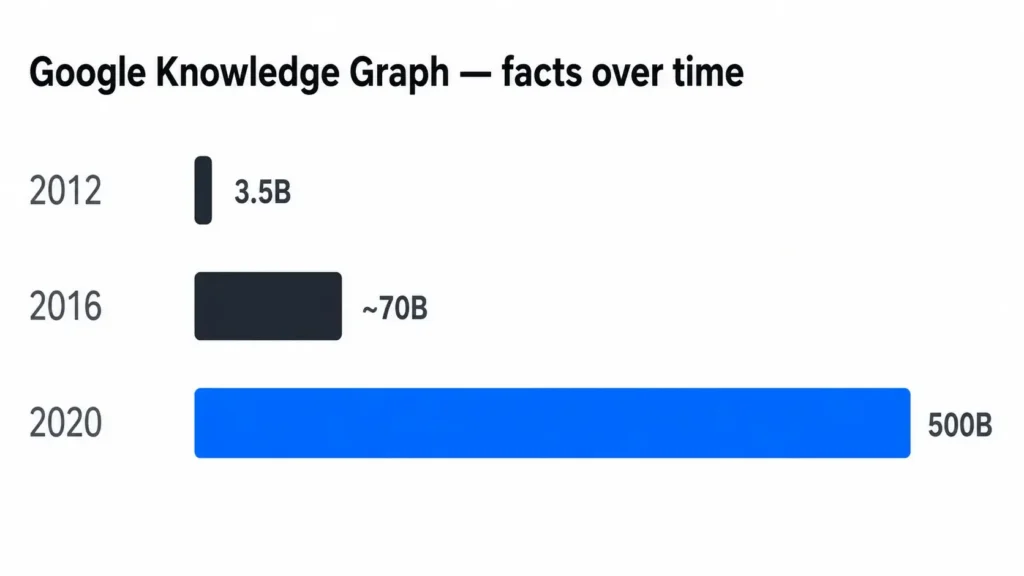
- The knowledge graph is the substrate. Google’s grew from 3.5 billion facts at launch (2012) to 500 billion facts across 5 billion entities by 2020 (Google, via Wikipedia, 2020).
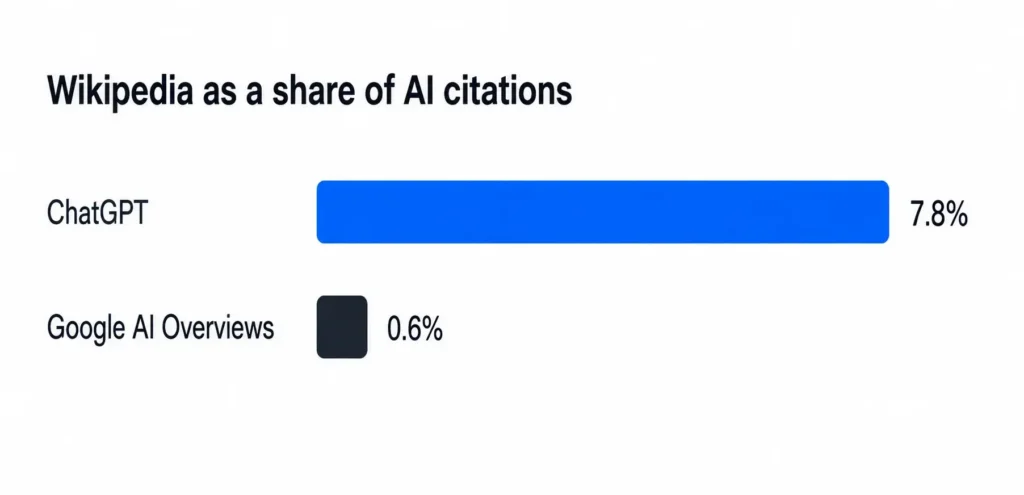
- Corroboration beats self-assertion. Wikipedia is ChatGPT’s single most-cited source at 7.8% of all citations (Profound, 2025) third-party validation, not your own copy.
- Mentions are the entity currency. Branded web mentions correlate with AI visibility at 0.664 vs 0.218 for backlinks (Ahrefs, 2025).
- Trust is the top signal. Google says “E-E-A-T itself isn’t a specific ranking factor,” but “trust is most important” (Google Search Central, 2025).
An entity is a distinct “thing” a brand, person, product, or place that machines recognize as one identifiable node with attributes and relationships, and entity authority is how strongly and consistently that node is established across the web. Search stopped being about strings and started being about things more than a decade ago. Google’s Knowledge Graph is the clearest expression of that: a machine-readable map of entities and the facts connecting them.
Its scale tells you how central this is. At launch in 2012, Google described the Knowledge Graph as holding “500 million objects, and more than 3.5 billion facts”; by 2020, Google put it at 500 billion facts about 5 billion entities (Google, via Wikipedia, 2020). That substrate the map of things and how they relate is exactly what modern AI systems lean on to ground their answers in something verifiable.
When an AI model decides whether to name your brand, it’s implicitly asking: is this a real, well-defined entity the rest of the web corroborates? The stronger your answer, the safer it is to cite you. For where this fits in the broader picture, see my GEO playbook → .
Because a model can’t afford to be wrong, it prefers to ground answers in entities that many independent sources agree on corroboration lowers its risk. A single page making a claim about itself is weak evidence. A brand described consistently across Wikipedia, LinkedIn, review sites, industry roundups, and its own pages is a pattern and patterns are what machines trust.
This is why entity authority behaves like a moat. On-page tricks are copyable in an afternoon; a decade of consistent, corroborated presence is not. The brands winning AI citations tend to be the ones the web has already agreed exist and matter which is also why unknown brands struggle to break in even with better content. Several GEO vendors report a stark “winner-take-most” concentration in AI citations (one estimates a small fraction of brands capture the majority of recommendations), and while those exact ratios are vendor-reported and vary, the direction matches everything else: established entities dominate.
The single clearest entity-trust signal is a well-sourced Wikipedia or Wikidata presence, because AI systems lean on them as grounding anchors. In a 2025 analysis of 680 million citations, Profound found Wikipedia was ChatGPT’s most-cited source, at 7.8% of all its citations (Profound, 2025). The engines differ that same study found Google’s AI Overviews cited Wikipedia only about 0.6% of the time, and Perplexity leans more on community sources but the throughline is that a corroborated encyclopedic entity is disproportionately trusted.
This isn’t accidental. In late 2025, Wikimedia launched a structured Wikidata and Wikipedia grounding layer aimed explicitly at LLMs and AI developers (IBM, 2025) the encyclopedic entity graph is being deliberately wired into AI. The practical read: if you genuinely meet notability guidelines, a well-sourced Wikipedia/Wikidata entity is high-leverage. If you don’t, a self-promotional page gets reverted fast, so build the corroboration that would justify one first.
You build entity authority mainly by being mentioned talked about across the web not by accumulating backlinks. This is the finding that reorders most SEO priorities. In a 2025 study of 75,000 brands, Ahrefs measured what correlates with AI visibility and found branded signals dominating: YouTube mentions at 0.737, branded web mentions at 0.664, and traditional backlinks trailing at about 0.218 (Ahrefs, 2025).
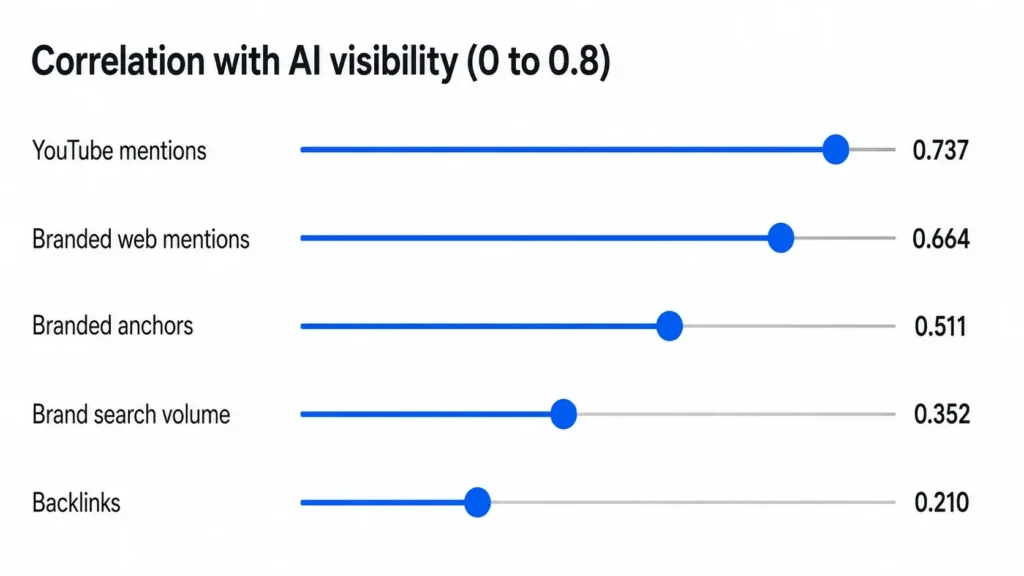
Source: Ahrefs, 2025. Brand mentions correlate ~3× stronger than backlinks.
Read that as a mandate: getting your brand said on YouTube, in roundups, on Reddit and LinkedIn, across review sites builds the entity more than another link-building sprint. Each mention is another independent source corroborating that you exist and matter.
A machine can only resolve you into one confident entity if your identity is consistent everywhere contradictory facts fracture the node. The knowledge-graph literature is explicit that construction errors “arise when the training data are sparse, ambiguous or contradictory” (MDPI, 2024). Translate that to your brand: three different company descriptions, a name that’s stylized four ways, mismatched founding dates or locations, and an author who appears under two bylines all make you harder to resolve and a model that can’t cleanly resolve you is less likely to cite you.
Consistency is the unglamorous half of entity authority. Use one canonical brand name, one crisp description, one set of core facts, and reinforce them with Organization schema and sameAs links to your official profiles so machines can tie the identities together. Google confirms Organization structured data helps it “disambiguate your organization” (Google Search Central, 2026) though, to be honest, that’s an understanding aid, not a documented citation booster. I cover the markup side in Schema Markup for AI Citations → .
Who publishes your content is itself an entity signal, and Google’s guidance leans hard on it. Google’s official position is careful: “E-E-A-T itself isn’t a specific ranking factor,” but its systems “use a mix of factors that can identify content with good E-E-A-T,” and of the four, “trust is most important” (Google Search Central, 2025). The same guidance asks whether it’s “self-evident who authored your content” and recommends accurate bylines where readers expect them.
So build author entities the way you build brand entities: real bylines tied to a consistent Person identity, off-site presence for your experts, and sameAs links connecting an author’s profiles. Google officially frames E-E-A-T as a quality concept its raters assess, not a dial; practitioners infer that clear author and brand entities strengthen the signals Google’s systems reward. That’s a reasonable bet just don’t sell it as Google doctrine.
Establish one clear identity, corroborate it widely, and keep it consistent then let it compound. The playbook, in priority order:
sameAs to your official profiles.Want to know how AI sees your brand today? Book a free strategy call → and I’ll show you where your entity is ambiguous, contradicted, or invisible and what to fix first.
Entity authority is how strongly and consistently your brand, people, and products are established as recognizable “things” across the web and in knowledge graphs like Google’s which grew to about 500 billion facts across 5 billion entities by 2020 (Google, via Wikipedia, 2020). The stronger and more corroborated your entity, the more confidently search and AI systems can identify and cite you.
Define one canonical identity, corroborate it with widespread brand mentions, and keep every fact consistent. Branded web mentions correlate with AI visibility far more than backlinks 0.664 versus 0.218 in a 2025 Ahrefs study (Ahrefs, 2025) so getting talked about across YouTube, Reddit, LinkedIn, and review sites is the core work, reinforced by Organization and Person schema.
It’s one of the strongest entity-trust anchors. In a 2025 analysis of 680 million citations, Wikipedia was ChatGPT’s most-cited source at 7.8% of all citations (Profound, 2025), and Wikimedia has built a Wikidata grounding layer specifically for AI. Only pursue a page if you genuinely meet notability guidelines otherwise build the third-party corroboration first.
No, not directly. Google states plainly that “E-E-A-T itself isn’t a specific ranking factor,” while its systems “use a mix of factors that can identify content with good E-E-A-T,” and trust is the most important of the four (Google Search Central, 2025). Clear author and brand entities are widely believed to strengthen those signals, but that’s practitioner inference, not an official ranking dial.
Entity authority is the part of AI visibility you can’t shortcut, which is exactly why it’s worth building. Pages and schema are table stakes; the moat is the accumulated, corroborated agreement across the web that you are a real, consistent, trustworthy entity. AI engines cite what they can confidently identify so make yourself unmistakable.
The short version:
I track how AI identifies and cites brands on my own site, and entity strength is the pattern under almost every result. Want yours mapped and strengthened? Let’s talk →. Start with my GEO playbook → and my Schema Markup for AI Citations Guide → .
Sources retrieved 2026-08-04: