

You’re about to hand someone your website, a monthly budget, and a big chunk of trust. The odds aren’t automatically in your favor: in 2026, only about 30% of SEO clients said they’d recommend their provider, putting the industry’s Net Promoter Score at roughly zero (Backlinko, 2026). The difference between a hire that pays for itself and one you quietly cancel in six months usually comes down to the questions you asked or didn’t before signing.
I’m an independent SEO consultant, and I’d rather you vet me hard than hire me blind. So here are the 15 questions I’d want a prospect to ask me, including the AI-search ones most providers still can’t answer.




Key Takeaways
- One question filters most bad hires: “Can you show me a site you grew, with before/after data I can verify?” because 82% of clients who leave do so over disappointing business results (Backlinko, 2026).
- Guarantees are the reddest flag. Google states plainly: “No one can guarantee a #1 ranking on Google” (Google Search Central).
- Prices vary wildly: freelancers average ~$1,349/month, agencies ~$3,209 about 138% more (Ahrefs, 2025). Fit matters more than the number.
- A 2026 SEO must understand AI search. With organic clicks down ~61% on AI Overview queries (Seer Interactive, 2026), “we only do Google rankings” is no longer a full answer.
- Insist on timeline honesty: SEO typically takes 6–12 months just to break even (Backlinko, 2026).
Ask: “Can you show me a website you’ve grown, with before-and-after data I can independently verify?” It works because results are what people actually leave over in 2026, Backlinko found 82% of clients who fired their SEO provider did so out of dissatisfaction with business outcomes, not tactics (Backlinko, 2026). Vague answers here predict a vague engagement.
A strong consultant will show you a real domain (or an anonymized-but-checkable case), name the metric that moved, and tell you honestly what they can’t take credit for. Evasion, name-drops without data, or “I can’t share that because of NDAs” every single time are all signals to keep looking.
Because “ranking on Google” stopped being the whole job. AI Overviews now cut organic click-through by roughly 61% on the queries they appear on (Seer Interactive, 2026), and about 88% of citations in Google’s AI Mode come from pages that don’t even rank in the organic results (Moz, via Ahrefs, 2026). A consultant optimizing only for blue links is solving half your problem.
That’s why several of the questions below probe AI search directly. It’s the fastest way to tell whether someone has updated their playbook since 2023 or is still selling the old one. For the full picture, see my Generative Engine Optimization Playbook →

Start here, because strategy is where good and bad consultants separate fastest. Only about 34% of qualified leads come from SEO on average (Backlinko, 2026), so you want someone who ties their plan to leads and revenue, not just rankings. These five questions expose whether there’s a real plan or just activity.
1. “What would you focus on in my first 90 days, and why?” You’re listening for a diagnosis-first answer (audit, indexing, quick wins) rather than a generic “we’ll publish blogs and build links.”
2. “How do you decide which keywords and pages to prioritize?” Good answers mention search intent, business value, and competitive difficulty not just search volume.
3. “Can you walk me through a similar site you’ve grown?” The verifiable-results question from above, applied to your niche and size.
4. “What will you need from me and my team to succeed?” A consultant who expects zero input from you is over-promising; real SEO needs content access, dev time, and decisions.
5. “How do you balance technical SEO, content, and off-site work?” You want a coherent theory of your specific bottleneck, not a one-size template.
This block is where 2026 hires are won or lost. A quarter of clients admit they weren’t even sure what they were paying for, and 27% found SEO offerings confusing (Backlinko, 2026). Clear measurement is the antidote and it now has to include AI visibility, not just Google position.
6. “Which metrics will you report, and how do they connect to leads or revenue?” Rankings and traffic are inputs; conversions and pipeline are outcomes. You want both, explicitly linked.
7. “How do you handle AI search do you track citations in ChatGPT, Perplexity, and AI Overviews?” This is the filter question of 2026. Since YouTube mentions now correlate with AI visibility far more strongly (0.737) than backlinks (0.22) (Ahrefs, 2026), a modern SEO should have an off-site and AI-citation answer, not a blank stare.
8. “How will we define success at 3, 6, and 12 months?” Concrete, staged milestones beat “trust the process.”
9. “How often will we meet, and what does a typical report look like?” Ask to see a real (redacted) sample. Confusing reports are a documented churn driver.
10. “If results are slow, how do you diagnose and change course?” Great consultants have a troubleshooting method; weak ones just ask for more time.
Now the commercial and trust questions. Churn in this industry is brutal 65% of clients have used multiple SEO providers, 25% have used three or more, and about 10% are “rapid switchers” who cycle through three or more in a single year (Backlinko, 2026). These questions help you not become one of them.
11. “Who actually does the work — you, or a subcontractor?” Fine either way, as long as it’s disclosed. Hidden outsourcing is the problem.
12. “How do you price, and exactly what’s included?” Roughly 78% of providers bill a monthly retainer (Ahrefs, 2025). Get scope, deliverables, and exclusions in writing.
13. “Do you require a long contract, and what’s the cancellation policy?” A provider confident in their work rarely needs to trap you in a 12-month lock-in.
14. “Can you guarantee me a #1 ranking or a specific result?” The correct answer is no. Google is unambiguous: “No one can guarantee a #1 ranking on Google. Beware of SEOs that claim to guarantee rankings” and its 2026 guidance even urges filing FTC complaints against deceptive SEOs (Google Search Central). Anyone who says “yes” just failed the interview.
15. “Tell me about a recent Google update and how you responded.” This checks whether they’re current. A specific, recent example signals someone who’s actually in the arena.
Use this as your gut-check after the calls. If most answers land in the left column, you’ve likely found a keeper.
| Green flags ✅ | Red flags 🚩 |
|---|---|
| Shows verifiable before/after results | “I can’t share any results” — every time |
| Diagnosis-first 90-day plan | Generic “blogs + links” package |
| Ties reporting to leads/revenue | Reports only rankings and traffic |
| Has an AI-search / citation answer | “AI search isn’t real SEO” |
| Says results take 6–12 months | Guarantees fast rankings |
| Month-to-month or short contract | Demands a 12-month lock-in |
| Transparent pricing and scope | Vague about what’s included |
| Names a recent algorithm change | Can’t recall anything recent |
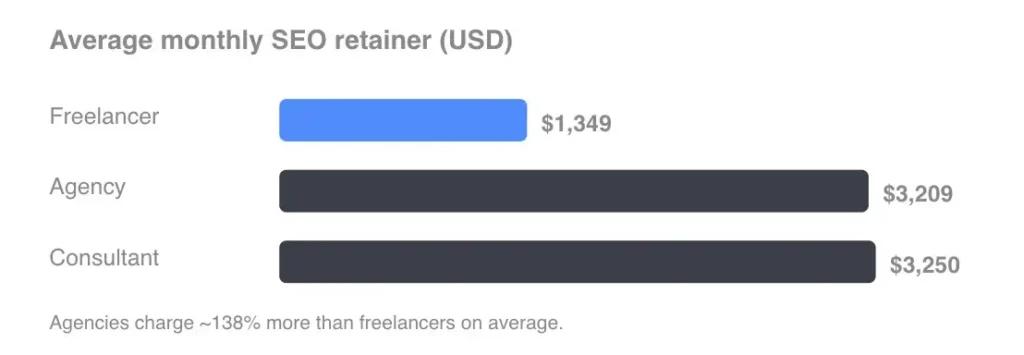
Source: Ahrefs SEO Pricing survey of 439 providers, 2025.
Want to run all 15 on me? Book a free, no-pitch discovery call grab a 20-minute slot → and put me through the checklist yourself. Worst case, you leave with a sharper hiring shortlist.
For transparency, here’s my short version. My 90-day plan is diagnosis-first (technical audit, then quick wins, then a content and AI-citation roadmap). I report on leads and citation share of voice, not just rankings. I track AI visibility across ChatGPT, Perplexity, and AI Overviews on a fixed 15-query panel, and I test the whole method live on this very site so you can check my receipts.
I quote month-to-month wherever possible, I tell clients plainly that meaningful movement takes 6–12 months, and I will never guarantee a ranking. If a competing provider does guarantee one, that’s your cue not your bargain.

It depends on scope and budget. Freelancers and solo consultants average ~$1,349/month, agencies ~$3,209 about 138% more (Ahrefs, 2025). A consultant suits focused, senior, hands-on work; an agency suits broad multi-channel execution; in-house suits large ongoing programs. Match the model to your actual needs, not the logo.
The fastest tells: ask for verifiable results (82% of clients leave over poor outcomes), ask if they guarantee rankings (they shouldn’t Google warns against it), and ask them to name a recent algorithm update. Vague, evasive, or guarantee-laden answers are your red flags (Backlinko; Google Search Central).
Yes. With organic clicks down ~61% on AI Overview queries and ~88% of AI Mode citations coming from outside the top rankings (Seer Interactive; Ahrefs, 2026), a 2026 SEO who can’t discuss ChatGPT, Perplexity, and AI Overviews is working with an outdated map. See my GEO playbook → .
Ask for a verifiable case study on a live domain, then confirm it yourself: check the site’s growth in a tool like Ahrefs or Semrush, read third-party reviews (Google, Clutch, LinkedIn recommendations), and ask to speak with a current client. Since 65% of clients have churned through multiple providers (Backlinko, 2026), independent verification beats a polished pitch deck.
Hiring an SEO consultant in 2026 isn’t about finding the cheapest quote or the biggest promise it’s about finding the person who tells you the truth about timelines, shows you real results, and understands that visibility now lives in AI answers as much as Google rankings.
The short checklist:
I test every one of these standards on my own site, in public. If you’d like to ask me all 15 yourself, let’s talk →.
Sources retrieved 2026-07-18: