
You still rank. Your traffic still fell. If that’s your 2026, you’ve met the AI Overview the AI-generated answer box that now sits above the blue links and answers the query before anyone scrolls. The clicks didn’t disappear evenly, though: brands cited inside an AI Overview earn about 35% more organic clicks, and 91% more paid clicks, than uncited brands on the same result (Seer Interactive, via QuickSEO, 2026).
This is a field guide to landing on the winning side of that split. I run these tactics on seofreelancerguru.com and report what moves including the uncomfortable finding that the one tactic everyone sells (schema) isn’t the lever they claim. It’s a companion to my GEO playbook →




Key Takeaways
- AI Overviews cut organic click-through ~61% on the queries they appear on (Seer Interactive, 2026) but cited brands earn ~35% more clicks.
- They’re concentrated on informational queries; B2B tech sees ~70% AI Overview exposure versus ~4% for ecommerce (Stackmatix, 2026).
- Ranking still helps, but no longer suffices. The share of AI Overview citations that also rank in the top 10 fell from ~76% to ~38% in under a year (Ahrefs, via Search Engine Journal, 2026).
- Google says there’s no special schema for AI Overviews (Google Search Central). Keep schema for rich results, not as an AIO shortcut.
- Track it in Search Console’s new Generative AI repor but note it’s impressions-only for now (Google, June 2026).
AI Overview optimization is the practice of getting your page cited and quoted inside Google’s AI-generated answer box, not just ranked beneath it. It matters because the answer box intercepts the click: Seer Interactive found organic click-through on AI Overview queries fell about 61%, from 1.76% to 0.61%, in its 2026 analysis (Seer Interactive, 2026). Ranking earns you a spot on the page; optimization earns you a spot in the answer.
It’s the Google-specific slice of the broader discipline I call generative engine optimization. The mindset is the same as for How to Rank on Chatgpt be the source the machine chooses to cite.
Mostly informational ones. Depending on the tracker, AI Overviews appear on roughly 15–25% of all Google queries as of early 2026 Semrush’s Sensor put it near 15% in late 2025 after a mid-year peak (Semrush, 2026) but the rate climbs sharply for “how-to” and “what-is” searches. Around 88% of AI Overviews appear for informational queries (Stackmatix, 2026).
Your exposure depends heavily on industry. Stackmatix reported B2B tech sees roughly 70% AI Overview exposure, while ecommerce sits near 4% (Stackmatix, 2026). If you publish informational B2B content, this is your problem to solve first. If you sell products, it’s a smaller fire for now.
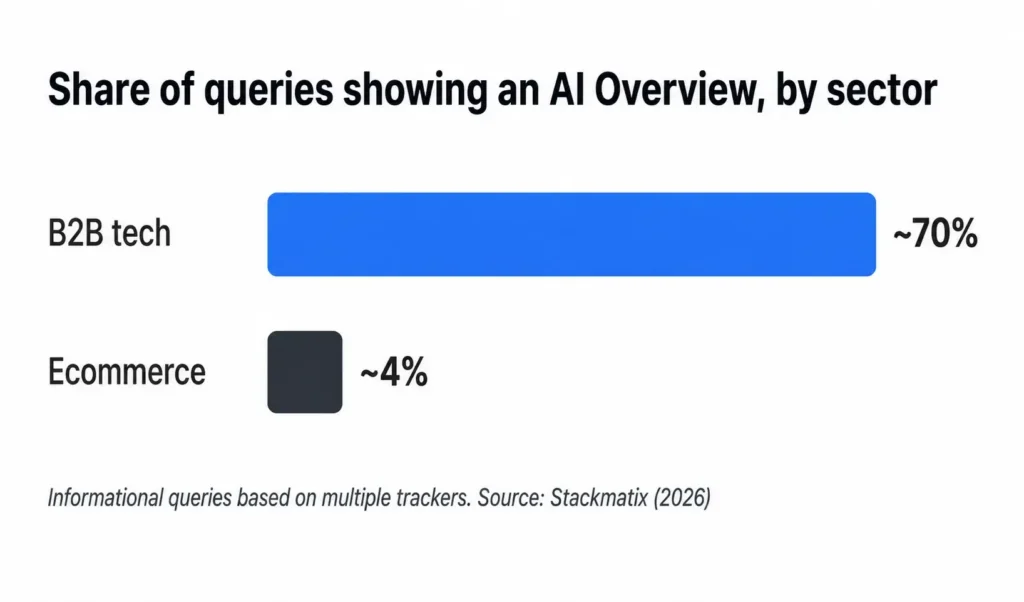
Source: Stackmatix, Google AI Overview SEO Impact, 2026.
It pulls from strong organic pages, but far less exclusively than it used to. In 2026, Ahrefs found the share of AI Overview citations that also rank in Google’s organic top 10 fell from about 76% in July 2025 to about 38% by March 2026 (Ahrefs, via Search Engine Journal, 2026). Ranking is still a strong foundation; it’s no longer a guarantee.
The mechanism is query fan-out: Google splits one search into many sub-questions and assembles an answer from pages that best resolve each fragment which is how a page outside the top 10 gets cited. This lines up with Moz’s finding that about 88% of AI Mode citations come from pages outside the organic SERP entirely (Moz, via Ahrefs, 2026). One honest caveat: Ahrefs notes its improved parsing makes the two time points not perfectly comparable, so read the trend, not the decimal.
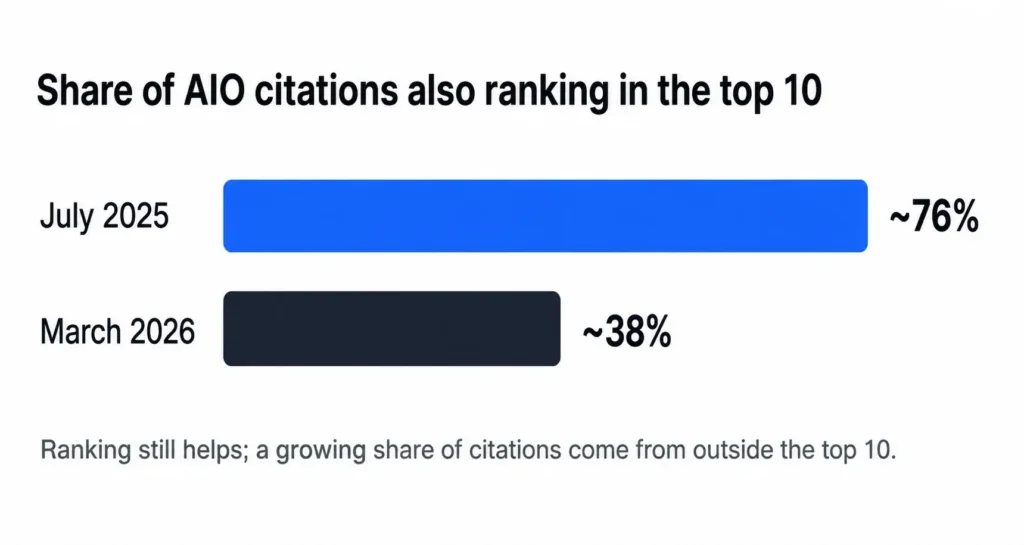
Source: Ahrefs (863k-keyword study), via Search Engine Journal, 2026.
Rank for the query, answer it extractably, prove topical authority, keep your entity consistent, and stay fresh. Notably absent from that list: special schema. Google is explicit that “there’s also no special schema.org structured data that you need to add” to appear in AI Overviews (Google Search Central). Here’s what actually works, in order.
AI Overviews still draw heavily on strong organic pages, so classic SEO remains your foundation. To be eligible at all, Google requires that your page is indexed, crawlable, and eligible for a snippet (Google Search Central). If your page can’t earn a normal snippet, it can’t be pulled into the answer. Start with the fundamentals in Why isnt my Website Ranking.
Lead each section with a self-contained answer of one or two sentences, then support it. Use lists, numbered steps, and tables with clear headers so a model can lift a clean chunk. Length alone won’t save you: Ahrefs measured essentially zero correlation (~0.04) between word count and citation (Semrush, 2026). Structure beats volume every time.
Google favors sources that demonstrably cover a topic, not one-off pages. A hub-and-spoke cluster a pillar plus interlinked spokes signals depth and gives the fan-out mechanism more of your pages to cite. This entire GEO cluster is built that way on purpose; see the GEO pillar → for the architecture.
Use the same brand name, the same terminology, and the same claims across every page. Contradictions confuse the entity model that decides whether Google trusts you as a source. Pick one label for each concept and hold it I use “GEO” throughout this site rather than alternating synonyms.
Google’s AI features lean toward current, accurate content. Update cornerstone pages on a roughly 30-day cadence refresh a stat, add an example, correct anything stale, and update the modified date honestly. Freshness is the cheapest signal on this list and one of the most reliable.
A note on schema, honestly: keep your Article, FAQ, and Organization markup it earns rich results in classic Search and reinforces your entity. Just don’t believe anyone selling “schema to rank in AI Overviews.” Google says there are “no additional requirements to appear in AI Overviews” beyond normal indexing (Google Search Central).
Losing clicks to AI Overviews? I’ll run a free AI Overview audit on your site Book a 20-minute call → and I’ll show you which of your queries now serve an AI answer without you in it.
Use the new Generative AI performance report, with one caveat: it’s impressions-only for now. Google launched the report in Search Console (Beta) on June 3, 2026, with separate views for Search covering AI Overviews and AI Mode and Discover (Google Search Central, 2026). It’s the first official window into AI-surface visibility.
The limitation matters: version one reports impressions but not clicks, CTR, position, or query data. So you still can’t see AI Overview clicks directly. The practical workaround, popularized by Brodie Clark, is to segment your standard Performance report and watch for the tell-tale divergence impressions holding or rising while clicks fall on informational queries (Brodie Clark, 2026). Don’t trust any tool promising a clean click-level AIO filter; Google’s own data doesn’t expose one yet.
Right now I’m running a controlled test: taking a cluster of informational pages, rewriting them answer-first, tightening entity consistency, and pushing off-site signals while holding schema constant to isolate what actually moves citations. I publish the results as they come in, including the tactics that flatline.
Early read: the answer-first rewrites and the freshness cadence move impressions faster than anything I do to markup consistent with Google’s own guidance.
Rank for the query, then make your answer easy to extract: lead each section with a concise, self-contained answer, use lists and tables, and prove topical authority with a complete content cluster. Google requires only that your page is indexed, crawlable, and snippet-eligible there’s no special markup (Google Search Central, 2026).
They can. Organic click-through drops about 61% on queries where an AI Overview appears (Seer Interactive, 2026). But the loss is uneven brands cited inside the overview earn roughly 35% more clicks than uncited ones. The goal isn’t to avoid AI Overviews; it’s to be cited in them.
None specifically. Google states there’s “no special schema.org structured data that you need to add” to appear in AI Overviews (Google Search Central, 2026). Keep Article, FAQ, and Organization schema for rich-result eligibility in classic Search and entity clarity just don’t expect it to be an AI Overview ranking lever.
Informational and B2B sectors, by a wide margin. Stackmatix reported roughly 70% AI Overview exposure for B2B tech versus about 4% for ecommerce (Stackmatix, 2026). Any business built on “how-to” and “what-is” search demand feels this most; transactional and product queries far less.
AI Overviews didn’t kill your rankings they added a second gate above them. Clearing it isn’t mystical, and it definitely isn’t a schema trick. It’s the unglamorous fundamentals done deliberately: rank, answer extractably, prove depth, stay consistent, keep it fresh.
The short version:
I’m testing all of this live on my own site, wins and flops alike. If you’d rather have a specialist run it for you, let’s talk →. To go wider, start with the GEO playbook → and Getting Recommended by ChatGPT → .
Sources retrieved 2026-07-18: