

Let me save you a weekend. If you’re adding FAQPage schema to every post because you read it “gets you cited by ChatGPT,” stop that’s not what the evidence shows. Schema markup is worth doing in 2026, but for reasons almost nobody states honestly: it helps machines understand who you are and what your page is about. It is not a citation lever, and the best data we have says so plainly.
I run structured data across seofreelancerguru.com, so this is the version I’d give a client who asked “should we invest in schema for AI search?” the real answer, the study that settles it, and the markup that’s actually worth your time.






Key Takeaways
- Google’s official position: there’s no special schema you need to appear in AI Overviews or AI Mode they run on the same index as regular Search (Google Search Central, 2026).
- The best study to date found no lift. Ahrefs tracked 1,885 pages that added schema and measured AI Overviews −4.6%, AI Mode +2.4%, ChatGPT +2.2 none of it a citation gain (Ahrefs, 2026).
- The viral “+44% citations from schema” stat is a myt it’s a BrightEdge figure about negative brand sentiment, not schema (BrightEdge, 2026).
- FAQPage and HowTo rich results are dead. Google fully removed FAQ rich results in May 2026; HowTo went in 2023 (Search Engine Journal, 2026).
- The schema that earns its keep is Organization + entity marku
sameAs,@id, and consistent identity that helps machines resolve who you are.
No — no credible evidence shows schema causes AI citations, and Google explicitly says none is required. In its official guidance, Google states you don’t need to create special files or markup to appear in AI features, adding that “there’s also no special schema.org structured data that you need to add” (Google Search Central, 2026). AI Overviews and AI Mode draw from the same index and ranking systems as normal Search. There is no secret “AI schema.”
The strongest test of the popular belief comes from Ahrefs. In 2026, they ran a matched difference-in-differences study on 1,885 pages that added JSON-LD, against roughly 4,000 controls, measuring AI citations before and after. The result: AI Overviews moved −4.6%, AI Mode +2.4%, and ChatGPT +2.2% the two positives statistically indistinguishable from zero, and the AIO figure slightly negative (Ahrefs, 2026). Their verdict: adding schema didn’t increase AI citations on any platform.
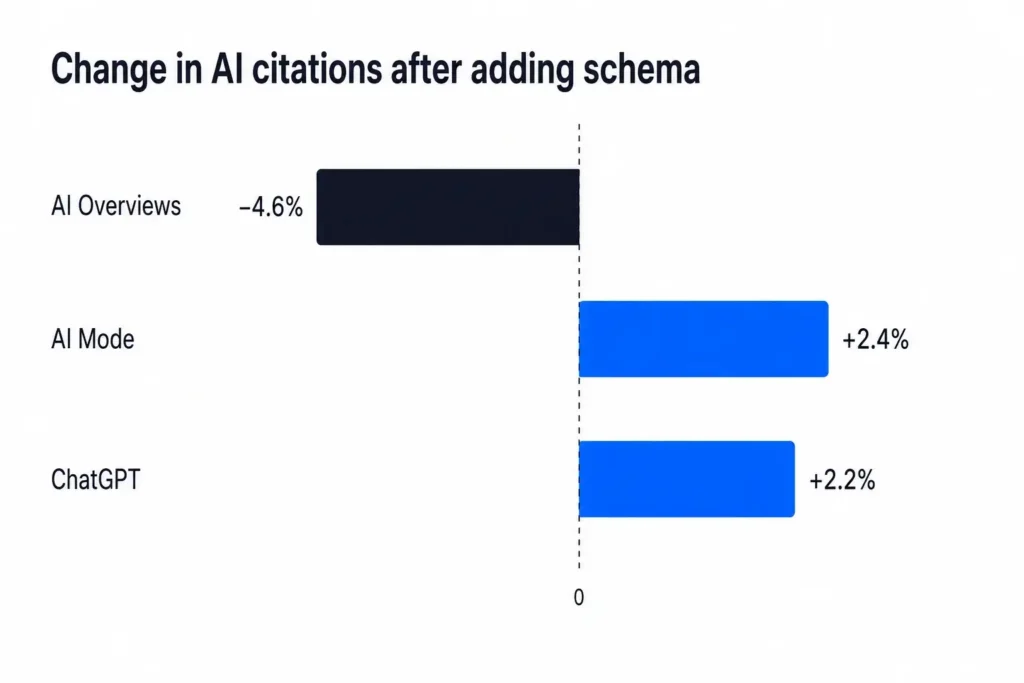
One honest caveat, straight from the researchers: every page tested already had 100+ AI citations, so the study measures the effect on already-visible pages not whether schema helps an unseen page get crawled, parsed, and into the citation pool in the first place (Ahrefs, 2026). That remaining upside is real but unproven. Which is exactly why you still add schema just not for the reason you were told.
Because schema helps machines understand and correctly identify your content and that understanding is the foundation everything else sits on. Google’s own framing is that structured data helps it understand a page and become eligible for rich results an understanding and eligibility aid, not a ranking booster (Google Search Central, 2026). Three concrete payoffs make it worth the effort:
Think of schema as making your content legible to machines, not as a magic citation button. Legibility is a precondition for being cited; it isn’t the citation itself. For how citations are actually earned, see my GEO playbook → .
Prioritize Organization, Article, Product, Review, and Breadcrumb and know that FAQPage and HowTo rich results are gone. This is where a lot of 2023-era advice is now actively wrong. Here’s the current status:
| Schema type | 2026 status | Worth adding? |
|---|---|---|
| Organization | Active entity disambiguation, logo, knowledge panel | Yes highest value |
| Article / BlogPosting | Active author, date, entity signals | Yes |
| Product / Review | Active rich results strict policies | Yes (commercial pages) |
| BreadcrumbList | Active site structure understanding | Yes |
| Person | Active author/entity disambiguation | Yes (author pages) |
| FAQPage | Rich result removed May 2026; still a valid type | Optional understanding only |
| HowTo | Rich result removed 2023; still valid | Optional no visual payoff |
Google fully removed FAQ rich results from Search around May 2026, after restricting them to government and health sites in 2023; HowTo rich results were dropped back in 2023 (Search Engine Journal, 2026). Both remain valid Schema.org types Google can still parse so keeping them is fine, but don’t expect a rich result or a citation bump. If you’re adding FAQPage hoping for AI citations, the Ahrefs data says you’re spending effort in the wrong place.
Organization schema with sameAs and @id linking is the highest-value structured data you can add, because it resolves who you are across the web. Google confirms that home-page Organization structured data helps it “understand your organization’s administrative details and disambiguate your organization in search results” (Google Search Central, 2026). The sameAs property connects your official profiles LinkedIn, Wikipedia, Wikidata, X telling machines they all refer to the same entity, which is how a unified knowledge-graph identity gets built.
Here’s a clean, correct starting point. It nests a Person author inside an Article, references a single Organization by @id, and uses sameAs for entity disambiguation:
{
  "@context": "https://schema.org",
  "@graph": [
    {
      "@type": "Organization",
      "@id": "https://example.com/#organization",
      "name": "Your Brand",
      "url": "https://example.com",
      "logo": "https://example.com/logo.png",
      "sameAs": [
        "https://www.linkedin.com/company/your-brand",
        "https://www.wikidata.org/wiki/Q000000",
        "https://x.com/yourbrand"
      ]
    },
    {
      "@type": "Person",
      "@id": "https://example.com/#person",
      "name": "Your Name",
      "url": "https://example.com/about",
      "sameAs": ["https://www.linkedin.com/in/your-name"],
      "worksFor": { "@id": "https://example.com/#organization" }
    },
    {
      "@type": "Article",
      "headline": "Your Article Title",
      "datePublished": "2026-08-04",
      "author": { "@id": "https://example.com/#person" },
      "publisher": { "@id": "https://example.com/#organization" }
    }
  ]
}
To be fully honest: Google documents the disambiguation benefit of this markup; it does not officially claim sameAs boosts AI citations. Treat entity schema as “helping machines resolve who you are” a reasonable, foundational bet not a guaranteed path into AI answers.
Use JSON-LD, and never mark up anything that isn’t visible on the page. Two rules from Google’s own guidelines carry most of the weight:
Beyond those: keep your JSON-LD valid (run it through Google’s Rich Results Test), keep author and date in the markup consistent with the visible byline, and reuse a single Organization @id across your pages so machines see one entity, not many.
The “+44% AI citations from schema” stat is fabricated, and “Google requires AI schema” is false. Both circulate widely, so name them:
Mismatched or deceptive structured data can cost you rich-result eligibility. Google’s guidance is precise: a structured-data manual action means “a page loses eligibility for appearance as a rich result; it doesn’t affect how the page ranks in Google web search” (Google Search Central, 2026). So the downside of gaming schema isn’t a ranking penalty it’s losing the rich results (and the machine trust) you added schema to earn. Marking up invisible content, faking reviews, or using irrelevant types are the fast ways to get there. Don’t.
Not directly. Google says no special schema is required for AI features (Google Search Central, 2026), and a 2026 Ahrefs study of 1,885 pages found adding schema produced no AI-citation lift on AI Overviews, AI Mode, or ChatGPT (Ahrefs, 2026). Schema helps machines understand your content and qualify for rich results, which is a foundation for visibility but it isn’t a citation lever.
None specifically AI Overviews use the same index as normal Search, so foundational SEO matters more than any markup (Google Search Central, 2026). That said, Organization, Article, Product, Review, and Breadcrumb schema remain worthwhile for entity understanding and rich-result eligibility. FAQPage and HowTo no longer produce rich results.
Only for machine understanding, not for a visual result. Google removed FAQ rich results in May 2026 and HowTo rich results back in 2023 (Search Engine Journal, 2026). Both are still valid Schema.org types that Google can parse, so keeping them is harmless just don’t expect rich snippets or AI citations from them.
Organization schema with sameAs and consistent @id entity linking. Google confirms it helps disambiguate your brand and build a unified entity understanding (Google Search Central, 2026). Entity clarity is the foundation AI grounding is most likely to benefit from, even though Google doesn’t officially claim it boosts citations.
Schema markup for AI citations is one of the most over-promised tactics in GEO. The honest version: add structured data to make your content legible and eligible, then spend your real energy where citations are actually won off-site mentions, freshness, and quotable, answer-first content.
The short version:
sameAs, @id, one consistent identity.Want your structured data audited and your GEO effort pointed where it actually pays? Book a free strategy call →. And for the parts that do move citations, start with my GEO playbook → and AI Overview Optimization Guide → .
Sources retrieved 2026-08-04: